
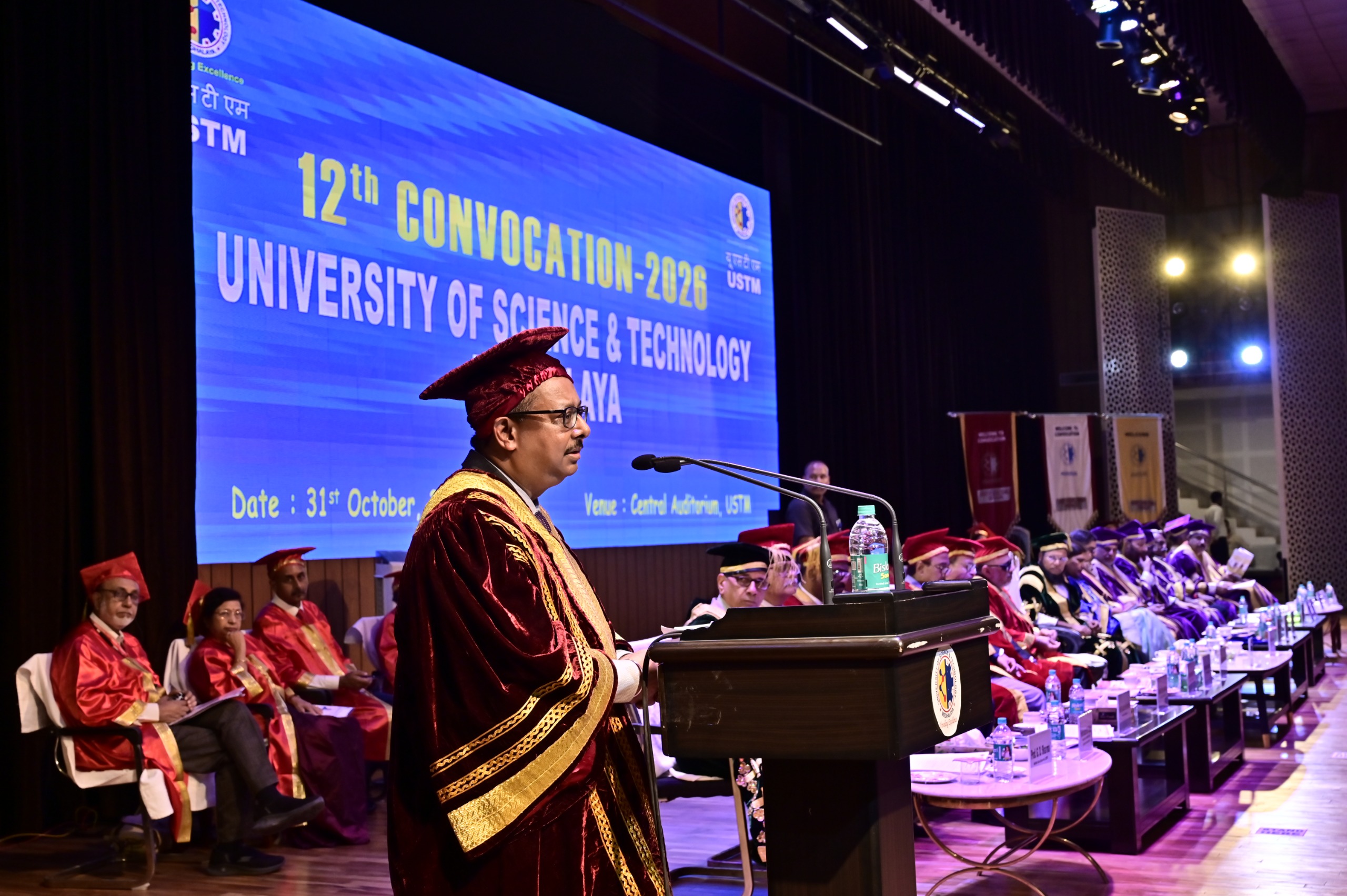
October 31, 2026 | Justice Ujjal Bhuyan:
A very good morning to all of you.
I am delighted to be present here amidst all of you this morning on the occasion of the 12th convocation ceremony of the University of Science and Technology Meghalaya (USTM).
I had visited this university about three years ago. During my first visit, I was highly impressed by the infrastructure put up by the university. I was also impressed by the commitment of the teachers and the management towards the university and its students. I could feel the vibrancy in the university campus. Today, as I revisit the university, I can sense the excitement and buzz within the university community here.
Thank you for having me here on this very special occasion.
Today is a proud moment not only for the students but also for the parents and teachers as well. For those students who have completed their under-graduate, post-graduate and doctoral courses, today marks a significant milestone in the journey of your lives. Today is the culmination of years of hard work, perseverance and learning. It is indeed a special occasion to be cherished, a moment of joy to be etched in your memory. So, I extend my warm felicitations to all the students who would be receiving their degrees today in various disciplines.
I take this opportunity to compliment USTM for the significant progress it has made within a relatively short span of twelve years and the reputation it has earned as one of the leading centers of learning not only in the North-East but beyond. The management, the faculty, the staff and the students deserve full credit for this. Though USTM has taken tremendous strides and has crossed one milestone after the other in its journey, it has still a long way to go. For an institution of excellence, the journey never ends. My congratulations and best wishes to the Chancellor Mr. Mahbubul Hoque, Vice-Chancellor Prof. (Dr.) Gauri Dutt Sharma and to the entire USTM team.
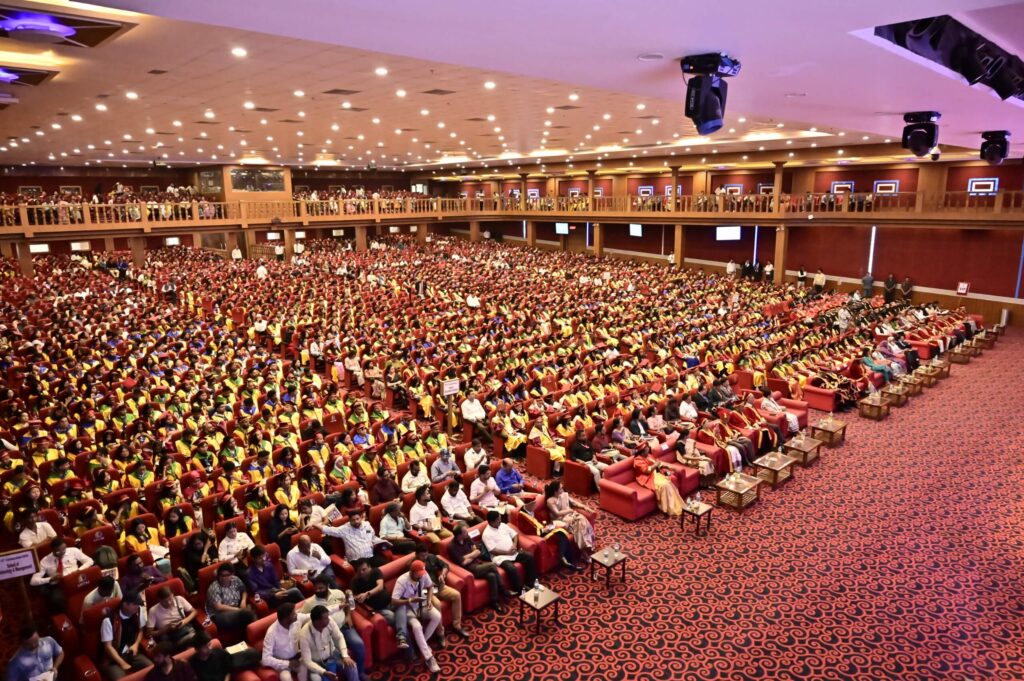
I also extend my warm congratulations to the proud parents and guardians, both present and in absentia, for the success of your wards. This day belongs to you as much as it belongs to your children. Your continued support has made this achievement of your children possible. But mind you: they may still be children to you; but to the outside world, they are the emerging citizenry about which I intend to speak today.
I would also like to compliment the teachers. It is because of your able guidance that the students have been able to achieve their success. Their success is as much yours as it is theirs.
At this moment, let me share with you an interesting story about Dr. APJ Abdul Kalam, our former President. He was asked in an interview: you have served as the President of India, you are an aerospace engineer, you have written books and you have been a professor; but what would you most like to be remembered as? Dr. Kalam replied that he would like to be remembered as a teacher and he gave the reason for this. A teacher has a fantastic opportunity to enrich the minds of young people, to give them dreams and to nurture those dreams along with them. He said that, in the process, the students become great human beings and sometimes they may even become better than their teachers. That is the opportunity that a teacher has.
I, therefore, congratulate all the teachers for their hard work and dedication.
Friends, the basic objective of education is not merely to equip a student with the requisite skills to earn a livelihood but to cultivate the mind and to elevate the spirit. Today, I am reminded of what Aristotle had said centuries ago: education is an ornament in prosperity and a refuge in adversity. Albert Einstein had famously said: education is not the learning of facts but the training of the mind to think. Education shapes the mind, broadens our horizons and gives purpose to knowledge. As Dr. B.R. Ambedkar had so aptly said: cultivation of mind should be the ultimate aim of human existence. Let me also refer to what Martin Luther King Jr. had said and I quote: the function of education, therefore, is to teach the students to think intensively and critically.
Therefore, education is much more than acquiring textbook knowledge or graduating with degrees. Its purpose is to shape the way we think and the way we relate to the world around us.
One of India’s greatest lawyers, Nani Palkhivala, in one of his remarkable addresses[1] described education as the technique of transmitting civilization and said that it has to perform two major functions: it must enlighten the understanding, and it must enrich the character. According to him, the two marks of a truly educated man, are the capacity to think clearly and intellectual curiosity. He reminded the students that what is needed more than anything else is moral leadership founded on courage, intellectual integrity and a sense of values.
That was a speech he delivered in the University of Bangalore more than 5 decades ago.
If it was relevant then, it is equally relevant today.
Just come to think of it. In his younger days, though Palkhivala was always a brilliant student, he suffered from severe bouts of stammering but he could overcome such speech impediment due to his steely determination and rose to himalayan heights by becoming one of India’s greatest lawyers of all times. Such was the power of his vocabulary and oratorial skills that Justice H.R. Khanna who was a witness to several of Palkhivala’s court submissions is reported to have said that presiding judges would take a week to come out of the spell which Palkhivala would weave around them with the power of his words.
When we speak of modern education in India, it is impossible to ignore the contributions of Savitribai Phule (1831-1897), a great social reformer, a pioneer of women’s education and women’s rights. She alongwith her husband Jyotirao Phule, reverentially called Jyotiba Phule, can be said to be the torch bearers of the concept of equality in India. Her attempt at educating women met with stiff opposition not only from the conservative and orthodox sections of the society but also from people belonging to the depressed classes who all felt threatened by Phule’s disruption of the social order. She was a great pioneer, far far ahead of her times. One would be amazed to read some of her notable quotations which speaks volumes of her vision. On education, she had said:
Education is the path to liberation and empowerment; in educating women, we educate generations and shape a just society.
On the rights of women, she had declared:
Women’s rights are not a privilege but a fundamental aspect of human rights.
She also had her vision of justice and according to her:
Justice is not served until it reaches the last woman standing in the queue.
Mind you, she had expressed such views 150 years ago; yet it is so relevant and contemporary even today.
The foundation laid by the great social reformers like Savitribai Phule was built upon and articulated with great conviction by Dr. Ambedkar, the chief architect of the Indian Constitution.
A university holds a special place in the life of a student. It is not only a place of regulated learning but is also a place which nurtures exchange of unchained ideas that continuously challenges the frontiers of knowledge. Friends, our former President, Dr. Pranab Mukherjee, had once observed that universities should be the bastions of free thinking and exchange of creative ideas. I have already spoken at length about free speech, dissent and tolerance. So I am not going to deliberate on this aspect today though I intend to speak on a slightly different topic which is also connected with university life. According to Dr. Pranab Mukherjee, our premier institutions of higher learning are the vehicles on which India has to propel itself into a knowledge society. These temples of learning must resound with creativity. We should not close our windows but at the same time we should be cautious and be able to separate the grain from the chaff. Let there be free flow of knowledge because knowledge knows no boundary. We should encourage and embrace the exchange of ideas and knowledge, because this is the foundation of rational thinking.
A university is also a place to discover the diversity around you. You share space with your fellow students who hail from diverse backgrounds. They speak different languages; they belong to different faiths; and they hail from different regions with different ethnic backgrounds. Their upbringing, their food habits and consequently their ways of thinking may be different from yours; so also their cultural identities. This diversity tells us first to unlearn ourselves and then to discover shared values.
Our strength is our diversity. As the saying goes: our unity lies in our diversity. Therefore, diversity is to be cherished and not something which should be disowned.
Diversity teaches us valuable lessons of life. It reminds us that there can be a view different from yours. Therefore, it tells us to listen; to respect views different from our own, before we form an opinion. In this shared space, learning is not limited to textbooks. It is imbibed when we respect and understand each other’s point of view though we may have a differing opinion.
Understanding diversity will help us transition into a more inclusive and accommodative society. Because of competing claims and societal conflicts we easily fall into the trap of exclusiveness. Willingly or unwillingly we get drawn into a false narrative; the binary of ‘us’ and ‘they’.
Friends, for a more just and humane society, it is important that we should move away from such destructive binary of ‘us’ and ‘they’ and embrace the idea of oneness. Therefore, the narrative must shift from ‘us’ and ‘they’ to ‘we’. Not for nothing, the Preamble to the Constitution of India starts with the expression ‘We, the People of India’. The Constitution does not address only one section of India. It speaks to all citizens of India as equal members of the constitutional order. The concept of ‘we’ therefore gives constitutional expression to all people who are diverse in their identities but united by a constitutional framework. Therefore, ‘we’ represent a larger idea of belonging in which our individual identities or group identities do not diminish our shared constitutional unity.
This constitutional concept of ‘we’ enables diversity to co-exist with unity. Its genius lies in the fact that it does not seek to efface the differences; rather, it seeks to restore unity without demanding uniformity. It does not require that our individual identities should get subsumed in the larger whole. Diversity, therefore, is not an impediment to the constitutional project; rather, it infuses substance and meaning to it. It helps us in making the transition from the binary of ‘us’ and ‘they’ to the unifying concept of ‘we’.
This is the principle of fraternity that Dr. B.R. Ambedkar highlighted as being the heart and soul of the constitutional vision. It is based on respect for fellow human beings as ones who are equal, clothed with the same human dignity.
Our former President Dr. APJ Abdul Kalam often used to tell the students that the real purpose of education is to build the inner strengths that stay with a person long after formal learning ends. He used to highlight several qualities which a student should acquire[2], particularly the habit of inquiry. To inquire is to avoid accepting the very first explanation that comes our way; it tells us to look for reasons; and it trains the mind to search a little deeper than what appears at the surface. This is nothing else but the development of a scientific temper. This will protect the mind from prejudice and empower it to make independent thinking and choice possible.
Under Article 51A of the Constitution, it is the fundamental duty of every citizen of India to develop a scientific temper. To develop scientific temperament, you need not be a man of science. Scientific temper or temperament is not confined to or developed in laboratories or scientific institutions. All that you need is the capacity to think rationally; what you say or think must be based on reason. It is an attitude of inquiry and openness to examination. It cannot happen overnight. The germination has to take place in the university.
Science is the art of reasoning, so also is law. Science is evidence based, so also is law. Law teaches us to reason and to question. Not for nothing our Constitution is called a scientific document of transformation. It has transposed a deeply feudal society practising graded inequality into a modern forward looking society. If we believe, respect and follow the philosophy of our Constitution, it will usher in a spirit of inquiry and reform which is the sine qua non of scientific temper. Therefore, science and law are partners in the constitutional journey of our republic.
I consider this to be one of the most remarkable provisions of our Constitution. It does not merely ask us to acquire scientific knowledge. It asks us to cultivate a temperament, which is based on reason. It tells us to inquire, to question, to examine and, where necessary, to reform.
In a recent speech, I had highlighted the importance of scientific temper in the context of the rule of law. I believe, scientific temperament lays the foundation for the rule of law. This is because arbitrary power thrives on ignorance, fear and unexamined belief. A society that accepts claims without evidence is susceptible to superstitious beliefs and becomes vulnerable to mis-information. A society that fears questions becomes vulnerable to authoritarianism. A society that treats tradition as beyond scrutiny may fail to reform unjust practices.
This takes me to the last segment of my lecture which is the importance of public reasoning.
According to Nobel Laureate Amartya Sen[3], public reasoning can help us come to grips with what can be done to reduce or even to eliminate gigantic deprivations from which so many people across the globe suffer.
It is a simple idea, yet very powerful. When people talk to each other honestly, when they listen as much as they speak, and when they are willing to reason together, societies become stronger.
Interactive public reasoning can only lead to a meaningful debate and discussion which would be a step in the right direction.
A healthy public debate does not require everyone to arrive at the same conclusion. It allows different views to be expressed, examined and debated. As Joseph Joubert observed: it is better to debate a question without settling it, than to settle it without a debate.
This habit of public reasoning is the very essence of a healthy participatory democracy. But for that we need to have an informed citizenry. We can have an informed citizenry only when there is access to information. Therefore, information is the key.
The idea of public reasoning finds particular exposition in Amartya Sen’s The Idea of Justice. Sen distinguishes between institutional democracy and functional democracy. By the former, he means having institutions facilitating an elected government by holding periodical elections on the basis of adult franchise. He describes the latter as participatory governance which is based on public reasoning and discussion. For Sen, democracy, which is a basic feature of our Constitution, is not exhausted by representative institutions alone; it is concerned with the manner in which citizens participate in public decision making through which questions of justice are examined. In this sense, Sen connects democracy with his broader distinction between what he calls a ‘transactional-institutional’ approach and a ‘realization-focused’ approach to justice. The concern is not merely to identify just institutions, but to ask how in actual terms institutions and public processes can help us reduce injustice in the world in which we live.
Circulation of information and scrutiny by public reasoning thus becomes part of the due process by which a democratic society resonates with justice.
Friends, today we have talked about education, university, diversity and public reasoning. There is one more aspect which I just touched upon but it would need a separate interaction altogether. It is the subject of justice which is so fundamental to every society. Next time when we meet, we shall certainly discuss the concept of justice in its theoretical abstract as well as its practical application.
Each of the four concepts that we have discussed today, at first blush, would appear to be distinct and separate. But if we analyse closely, we will find that there is a golden thread running through the above four concepts of education, university, diversity and public reasoning. There are many more concepts which we have not discussed today like the concept of justice. All these concepts are intertwined. Together, these concepts will guide us through the path to a just and equitable society which is the ultimate goal of our Constitution.
Once again, I thank the university for inviting me to this very important function. My warmest congratulations to each one of the graduating students for your commendable achievements. I am sure all of you will be successful in whichever profession you choose to enter.
My best wishes to you all.
Thank you very much and God bless.
(Justice Ujjal Bhuyan)
[1]Nani A. Palkhivala, “The Treason of the Intellectual” (Convocation Address, The University of Bangalore, January 15, 1972)
[2]Address at the Special Convocation of the Kurukshetra University, Haryana by APJ Abdul Kalam on 25.05.2007.
[3]Commencement Address by Dr. Amartya Sen at Soka University on 23.05.2014.
